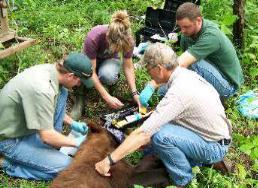
Caption: Wildlife Department personnel and
Researchers examine a northeast Oklahoma black
bear as part of an effort to establish the status and
distribution of the species in that region of the
state. The project is being conducted by the
Oklahoma Department of Wildlife Conservation in
partnership with the Oklahoma Cooperative Fish
and Wildlife Research Unit and the Department of
Natural Resource Ecology and Management at
Oklahoma State University. Pictured clockwise
from left: Curt Allen, northeast region wildlife
biologist for the Wildlife Department; Sara Lyda,
OSU research associate; Colby Farquhar, wildlife
technician for the Wildlife Department; and Craig
Endicott, northeast region wildlife supervisor for the
Wildlife Department.
“The goal of the project is to establish the status and distribution of black bears in the northeast
region of the state,” said Craig Endicott, northeast region wildlife supervisor for the Wildlife
Department and the project leader.
Still in its first year, the three-year research effort involves trapping bears for tagging and
collection of biological data such as measurements, age estimates and DNA samples.
With more than two years of studying still ahead, researchers have already trapped and
examined six bears, primarily in and around Sequoyah, Cherokee and Adair counties on both public
and private lands.
Some bears have been fitted with satellite-based GPS tracking collars that researchers use to
monitor range and breeding success. Collared female bears will be tracked to den sites where they
give birth to cubs in winter. The adult female can be temporarily sedated to collect data on her
overall condition and to mark and gather information on cubs. The high-tech collars do not inhibit
the bears’ normal activities, and they provide researchers with location readings at four key times
each day, providing details about individual ranges and habits. Trends and other important
information can be revealed in their findings.
“The GPS collars give us a fantastic look at the daily travels of the collared bears,” said Sara
Lyda, an OSU research associate working with the Wildlife Department to study bears in the region.
“We have already recorded that these females often travel seven to 10 miles per day within their
home ranges.”
In addition to trapping and tracking, hair samples are being collected with wire devices designed
to pluck strands of fur from bears’ hides as they travel to and from bait sites. Collecting DNA from
hair samples helps researchers identify individual bears and understand the genetic diversity of
bear populations in an area.
OSU also is working with Wildlife Department biologists, technicians and game wardens to
monitor bait stations placed throughout counties in northeast Oklahoma. This effort will indicate the
geographic range of black bears in the northeast region.
By studying range distributions, breeding success, body conditions, genetic diversity, feeding
habits and other data collected during the project, biologists will learn important information about
the health and stability of black bear populations in the northeast region.
Page 14