This is a SEO version of May2011-Finall. Click here to view full version
« Previous Page Table of Contents Next Page »Oklahoma Station Safari Trails – May 2011
THE DAY OF THE LONG STALK
I
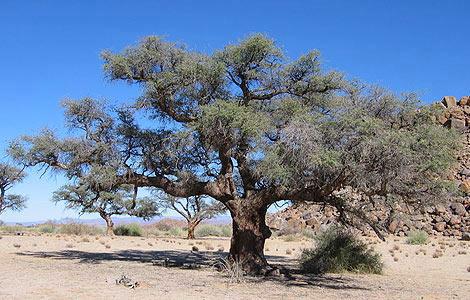
n September 2005 the wife and I flew from Tulsa to Atlanta and then on to Johannesburg with Windhoek, Namibia being our final destination. The 14 hour leg from Atlanta across the ocean was a killer. But, finally we set down in the capital of Namibia seeing nothing but camel thorn trees and scrub. The airport was modern, but the city was not in sight. We taxied in to spend the night in a very nice B&B to recover from the eight hour time change and get adjusted to “Africa time” prior to heading to camp.
Our P.H. was Joofie Lambrecht of Hunters Namibia. Joofie was right on time the next morning picking us up at 8:00 AM local time for the short drive, less than two hours, to the lodge. The Rooikraal Ranch is 60,000 acres of camel thorn and kopjes with two beautiful lodges. We stayed at the older and more traditional thatch roofed main lodge. Accommodations were first class. Our room on the second floor had a private bath, fireplace, and a private balcony overlooking the beautiful country.
This was my fourth trip to Africa and Pam’s second. Considering myself a “seasoned” traveler I had set several goals for this trip. First, it was to be a real vacation; no extensive list of species to acquire, no hunting from dawn to dusk every day, just a nice relaxed hunt enjoying the country, the accommodations and the camaraderie of the staff. Second, no shooting the first “representative trophy”. By keeping my needs list limited I wanted to focus on quality, not quantity. Third, since this was Pamela’s first shooting safari I told myself to kick back and relax when she was the hunter. This is another way of saying “keep out of the way and don’t play PH.”
The most difficult animal for me on this safari was the kudu. Many were present and many were sighted. The cows, juvenile bulls and other non-mature bulls would stand and stare giving themselves up to easy shots after a short approach. But, the old mature bulls were always teasing you with just a flick of the tail or horn and then disappearing into the brush when a man on foot or vehicle approached.
After an unproductive afternoon stalk on the fourth day I was beginning to be concerned about my kudu quest. I already had a good oryx and a good springbok in the salt. I had taken a decent kudu in Zimbabwe a few years ago, but wanted something better. On day five we were cruising the ranch roads through heavy cover when one of our trackers alerted us to a big kudu under a thorn tree some 300 yards off the track. After stopping the vehicle and evaluating the animal at length Joofie decided this was the one to pursue. It was going to be a tough approach through heavy brush and thorns. The wind was not favorable. We slipped out of the hunting vehicle and through a cattle fence. The trackers and Pamela were sent away in the original direction of travel so the kudu could see the vehicle disappear.
We crept through the brush, bending low and going slow. Every time we sighted the big bull he was glued to the same spot. The time was about 11:00 AM and with the temperature rising this old boy did not want to give up his spot in the shade during the heat of the day. The surrounding brush was so thick we could only view his head and horns at 100 yards. I had great difficulty seeing our quarry and had to have my binos right on him to make out his horns. The gray of his coat and his natural camouflage of vertical stripes reminded me of that old description, “gray ghost,” that is often applied to the greater kudu.
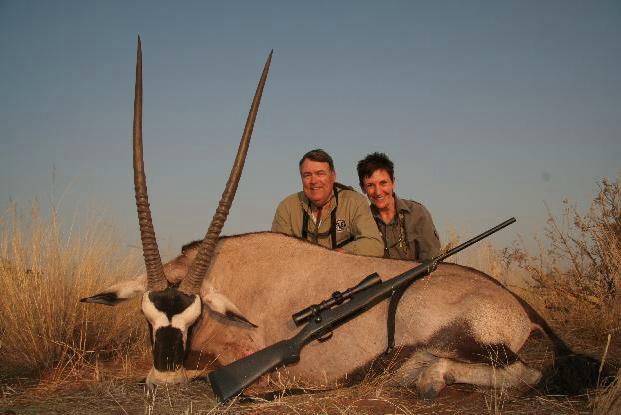
Greg’s Oryx
Page 28 Page 28
This is a SEO version of May2011-Finall. Click here to view full version
« Previous Page Table of Contents Next Page »